Why Dragging a Slider Beats Downloading Another Meditation App
Let's be honest. Most of us have downloaded at least three meditation apps in the last two years, opened them religiously for about a week, and then quietly let them collect digital dust somewhere between our banking app and a food delivery shortcut. The promise is always the same: sit still, breathe, let the guided voice carry you somewhere peaceful. And for some people, it genuinely works. But a growing number of Americans are finding their calm in a completely different place — inside a photo editor, nudging wave effects across a Sunday afternoon snapshot until something clicks.
This isn't a fringe habit. Over at WaveMyPic, longtime users have been talking about it for months. And now, the science is starting to catch up to what they've been feeling all along.
Your Brain on Repetition (The Good Kind)
When neuroscientists talk about therapeutic repetition, they're usually referencing activities like knitting, painting, or even raking sand in a Zen garden. The common thread? A rhythmic, low-stakes physical action that keeps the hands occupied while giving the conscious mind just enough to do — without overwhelming it.
Wave editing fits that description almost perfectly.
Dr. Marisa Caldwell, a cognitive psychologist based in Austin, Texas, has been studying what she calls "micro-creative loops" — short, repeatable creative actions that produce immediate visual feedback. "When you adjust a wave intensity slider and watch the image shift in real time, your brain gets a small but meaningful dopamine signal," she explains. "It's not the massive hit you'd get from, say, a gambling win. It's more like the consistent, gentle reinforcement you get from completing a puzzle piece. Over time, that rhythm becomes genuinely calming."
That's a meaningful distinction. Meditation apps often ask users to stop doing — to quiet the mind, resist the urge to engage. For a lot of people, especially those with anxiety or ADHD, that instruction is less like a life raft and more like being told to swim upstream. Wave editing, by contrast, gives the restless brain something to hold onto.
The Tactile Loop Meditation Apps Can't Replicate
There's a concept in psychology called "flow state" — that deeply absorbed mental space where time blurs and self-consciousness fades. Mihaly Csikszentmihalyi, the researcher who popularized the idea, argued that flow requires a task that's challenging enough to engage skill but not so hard it triggers frustration. Wave editing lands in that sweet spot for a lot of users.
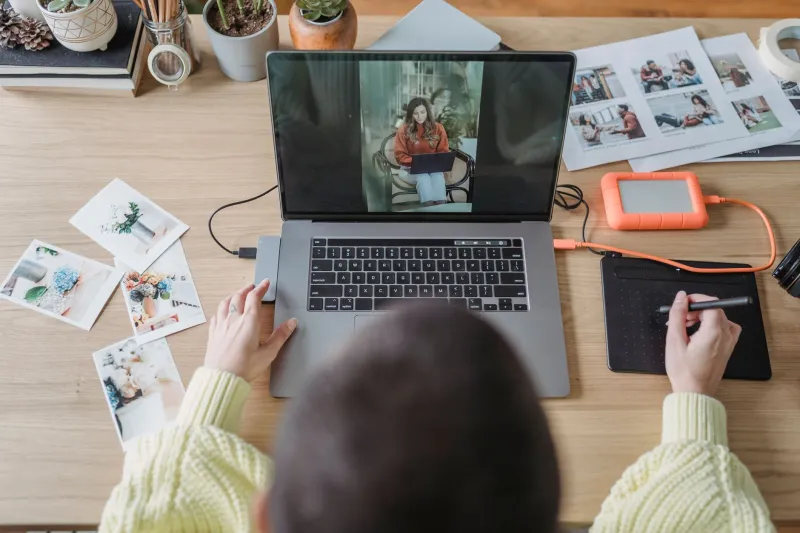
Jamie R., a 34-year-old teacher from Columbus, Ohio, started using WaveMyPic during a particularly rough stretch two winters ago. "I'd tried Calm, I'd tried Headspace, I'd tried just sitting with my thoughts," she says. "None of it worked because my brain wouldn't shut up. But when I'm editing — adjusting the ripple on a photo, tweaking the color bleed, layering effects — I'm just... in it. An hour goes by and I didn't think about my to-do list once."
What Jamie is describing isn't accidental. The act of manipulating visual elements engages the brain's occipital and parietal lobes simultaneously, while the decision-making involved — even small choices like whether to push a wave curve left or right — keeps the prefrontal cortex lightly occupied. That combination essentially crowds out the default mode network, the part of the brain most associated with rumination and anxious thought spirals.
In other words, your hands are busy, your eyes are engaged, your judgment is gently at work — and your inner critic doesn't have a free lane.
The Ritual Factor
One thing that separates genuinely therapeutic habits from one-off stress relief is ritual. Psychologists consistently find that repeated behaviors performed at predictable times carry greater mental health benefits than the same behaviors done sporadically. The routine itself becomes a cue that signals safety and calm to the nervous system.
A lot of dedicated WaveMyPic users have built editing into their daily rhythms in exactly this way. Marcus T., a 29-year-old graphic designer in Atlanta, edits for thirty minutes every morning before he opens his work email. "It's my buffer zone," he says. "I make my coffee, I sit down, I pull up whatever I shot the day before, and I just play with it. No pressure, no client notes, just me and the waves. By the time I actually start my workday, I feel like I've already done something good for myself."
That's not a coincidence. Morning creative rituals have been shown to reduce cortisol levels — the stress hormone — more effectively than passive consumption like scrolling social media or even watching TV. The key differentiator is agency. You're making something, not just receiving it.
Passive Wellness vs. Active Creativity
This gets at the core tension between wave editing and the mainstream wellness app model. Most meditation and mindfulness platforms are fundamentally passive experiences. You press play and follow instructions. The content does the work; you just have to comply.
There's real value in that, especially for beginners. But passivity has a ceiling. Research published in the Journal of Positive Psychology found that creative activities — defined broadly as any task involving self-expression and skill — produced significantly higher rates of reported well-being than passive relaxation techniques over a two-week tracking period. The act of making something, even something small, seems to satisfy a deeper human need than the act of simply unwinding.
Wave editing is creative in an accessible, low-barrier way. You don't need to be a trained photographer or a digital artist. You just need a photo and a willingness to play. The learning curve is gentle enough that beginners feel capable almost immediately, which generates its own positive feedback loop.
What the Science Suggests Going Forward
Researchers like Dr. Caldwell believe we're only beginning to understand how digital creative tools can be formally integrated into mental wellness strategies. "We already know art therapy works. We already know music therapy works," she says. "The question is whether scalable, app-based creative tools can deliver some of those same benefits outside a clinical setting. Early indicators suggest yes — especially for tools that involve repetition, visual feedback, and low-stakes decision-making."
Wave editing checks all three boxes.
None of this means you should delete your meditation app tomorrow. Different tools work for different brains, and there's no one-size-fits-all answer to mental wellness. But if you've tried the breathing exercises and the body scans and the guided visualizations, and something still feels like it's missing — it might be worth picking up a photo and seeing what happens when you let a wave move through it.
Sometimes the ripple you need isn't in a podcast. It's in the edit.